Tuesday, September 27, 2016

The REAL Way To Shell Popcorn!


After trying to get the popcorn off the cobs by hand, we decided there must be a better way!  Well, there is...............it's called a vintage Black Beauty Corn Sheller, circa early 1900's, made in St. Louis MO !  Our neighbor Frank had one of these contraptions and we asked if we could borrow it for a while.   This is a great little hand cranked machine that strips the corn kernels off the cobs, and even gives you the dry corn cob back easily!
We set up a big tub on the table, and decided to try the corn sheller.   Our popcorn isn't quite dry enough yet, but in a week or so we should be able to strip off all the popcorn a lot easier than doing it by hand.
A close up of the vintage corn sheller.   What an invention!
And it really works, too!
After stripping the corn kernels off the cob, this little vintage gadget even gives you the cob back easily !
You can see this is a Black Beauty corn sheller.   It says made in St. Louis MO.  A quick research on the internet shows that this was made around early 1900's or before (back when we actually made long lasting stuff in the good old USA!)


There is a You Tube video of one of these in action.  Hope this link works for you to see how neat it really works:
https://www.youtube.com/watch?v=rW3ZskBzAEs
(edited to add:  I see that this link does not work.  Well, if you go to You Tube and just type in Black Beauty corn sheller, it will be the first video on the list)
We just love using vintage machinery and gadgets to do things.  And when they actually work, that's even better.   Sometimes country boys have the neatest old toys.  Since we have 100 lbs of popcorn to shell, this will certainly make the job easier.

Saturday, September 24, 2016

Popcorn Party!

Today we harvested our popcorn crop.  Oh my, did we get a huge load of popcorn!  We estimate that we will have about 100 lbs of finished popcorn.   Can you believe that?  We can sell some at market when it is dry, and I think I know what everyone on our Christmas list will be getting this year as a gift from us!
     After the cobs dry a little bit on their own, we will don a pair of heavy rubber gloves and work all the kernels off the cob to dry further in flat pans.   We will have to keep testing them by popping some to see if we have the kernels dry enough.  When we do, we will put the popcorn in glass jars.  The popcorn will keep for years this way.   In fact, we are still eating the last of the 2012 popcorn, and it still pops up nice and big.   I think 100 lbs of popcorn should almost be a lifetime supply, eh?
     Here is a typical ear of popcorn:
The ears are very long and filled with kernels.  As you can see, almost every ear is at least 10 inches long.
 Harold gathered the ears and shucked them right in the corn patch, and brought out the ears in baskets.
Harold the "cornhusker"
He brought the ears out in baskets, and I cleaned them off a little more and put them in boxes to dry in the house.
Harold had lots of "help" from the farm cats who thought it was great fun to wander underfoot in the discarded husks!
Nine boxes of popcorn ears drying in the bay window in the sun.  Each box is at least 5 inches high and several layers deep.
All this talk of popcorn reminds me of one of my favorite books as a child - A story called "Popcorn Party" by Trudy Boyles and Louise MacMartin.  This book is from 1952.  It is a story about an old woman who wanted to give a party for the kids in her neighborhood, and decided to pop 5 lbs of popcorn all at once.   It filled her house with popcorn according to the story.   I must have read this book dozens of times as a child or had it read to me.  Such a cute little story!  My copy of the book was completely worn out and the cover was missing.   My sister found another copy of this book at an antique store a while back and bought it for me as a gift.   It is now in my library for grandchildren to look at.
A favorite book from my childhood!
A couple pages from the inside of the book.  Back in 1952 children's stories were full of cute illustrations.
So - I guess someday we can have our own 'popcorn party'!  But I won't pop 5 lbs at once!  Harold and I do enjoy popcorn as a snack on those long winter evenings when we play a game of Scrabble or cards together.   It's nice to know that we can grow our own snacks, too!  This year I also put lots of apple slices in the dehydrator, so we have bags of dried apple snacks, too.   Healthy snacks!

Wednesday, September 14, 2016

A Killing Frost

We had our killing frost last night.  It came a little early this year.  So the garden is done for 2016.  Not sure how low the temps were, but the cars and the ground and all vegetation was covered in a thick frost.   Well, I still have a few things growing in the greenhouse, which had no problems with frost!
A heavy frost covers everything, including weeds!
A row of dill and herbs encased in frost.
Some things were still in the growing/developing stages, so we could at least cover those things.  We put a large tarp over our watermelon patch in the hopes that the 5 huge melons out there would finish ripening.
About half the watermelon patch is covered.   There are 5 or 6 melons still needing to grow a little.  They are all about a foot in diameter, so we hope they make it!  Behind the melon patch you can see the corn that was planted using that antique corn planter (I have an older post about this on my blog).  Unfortunately, the deer ate just about all the corn in spite of an electric fence and a radio in the corn.  
A close up of one of the big watermelons we hope ripen a little more!
When the sun came up this morning, my cats found a way to keep warm:
Nine of my farm cats basking in the sun trying to keep warm while waiting for breakfast (or a foolhardy mouse to attempt to cross the yard in front of these 9 hunters!)

The fall season officially starts in a little over a week.  But up here in the north country, I guess  fall is here already!  Here in Minnesota we are now in the "winter is coming" mode.............

Monday, September 5, 2016

Honey Extraction 2016

Today we are extracting what little honey we will have this year.  We ended up with a little over 100 lbs, which is very poor compared to the 400 lbs of last year.   All the area beekeepers are complaining about poor harvests this year, so we aren't the only ones.   The reasons are several.   First of all we had a late freeze, which killed many of the wildflowers in the spring.   What flowers did survive, had a tough summer.  We had many sunny mornings, but then the rains came in the afternoon along with gusty winds.   By that time the flowers were open fully, and the heavy rains washed away a lot of the nectar and pollen on the flowers.  So there wasn't much "bee food" for the bees this summer.  This, along with the terrible policy of our state of Minnesota to mow the roadsides constantly (because of 'noxious weeds' they say) made for very few wildflowers this summer.   Also the bees don't get out to work in the rains and heavy winds.  It was truly a very rainy summer.
     Well, we at least got something!   Honey will just be at a premium this year.   We will have lots of disappointed customers who are asking for our honey.   We bottle our honey in pint jars, which hold about 1 & 1/2 lbs of honey, so you know 100 lbs won't go far.   We also need to keep plenty for ourselves, as I cook with honey and put it in all my homemade breads.
     Perhaps next year will be better!  Beekeepers are always hopeful!
So here is what today's process looked like:
Harold cuts off the wax cappings to release the honey for extraction.  We use a hot knife for this purpose.

After cutting off the cappings, there are sometimes a few left that didn't fit under the knife.   We use a fork to break up the wax on them.
In order to keep the knife hot enough, it is always soaking in a pot of hot water.   The handle of this knife is stained with bee propolis from many years of honey extraction.
We end up with lots of wax in the cutting tray.
A tub of wax cappings still has a lot of honey mixed in.  We will filter this through a 600 micron filter, and keep the honey for ourselves.  The wax will be melted down into a block and sold or used for candle making.
The inside of the extractor has lots of honey on the bottom.
The extractor spins out the honey from the frames.  The honey comes out of the honey gate at the bottom.  You can see that we already have nearly 2 buckets filled.   We have honey gates on the buckets, too, to make it easy to fill up the jars after the honey settles out bubbles.
Taking my turn at the extractor.   It takes about 5 minutes of cranking to empty the frames of honey.  We didn't put a motor on the extractor this year, as it didn't seem worth it just for 100 lbs.   We figured we could just crank it by hand this year!
As you might guess, the kitchen floor gets very sticky after this process!  It usually takes me a couple times of floor washing to get things clean.   We usually have a "honey party" every year and invite folks to help extract, and also to enjoy a food buffet.  But with such a low harvest this year, we decided it wasn't worth a party.    Like I said earlier............"there's always next year"!

Saturday, September 3, 2016

Laboring on Labor Day

It was a gorgeous late summer day today!  Plenty of breeze to keep the bugs away (the mosquitoes this year have been horrible!!!), low humidity, sunny, and certainly plenty to do!    With the weather folks predicting several days of rain in the future starting tonight, Harold and I decided to bring in our honey for the year.   This year's honey crop is not going to be very big.  Last year we harvested about 400 lbs, but this year we will be lucky to get 100 lbs.   It is great tasting, though, but scarce.   Not sure what the problem is exactly, but we believe it has something to do with the fact that there was just not an abundance of wildflowers this year, plus it was a very rainy and windy summer.   There wasn't the usual basswood blossom honey flow, and the typical clover crop was very scant this summer.  We usually have about 20 full supers of honey to extract, but this year there are only 10 boxes, and not all the frames are filled out.  Well, we shall take what we get, and hope for a better year.
The 3 boxes in front are practically empty, and there are only 10 supers to work with.   Honey will be at a premium this year unfortunately.
I also harvested my lima bean crop.   Lima beans are another one of those vegetables that people either love or hate.  Very few folks have ever tasted a truly fresh lima bean unless you grow them from your own garden.    Most everyone has eaten the typical frozen limas from the supermarket freezer.   One of my favorite late summer dishes is succotash:  freshly cut corn off the cob, limas, and plenty of butter with a little cream poured over all and mixed.    Really good succotash can only be made with absolutely fresh produce.
A big basket full of freshly picked lima beans.  They are a bother to pick (because they are hard to see as they look just like the leaves of the plant!) and even harder to pod out, but SO worth it!
The picture is a little blurry, but this shows the insides of the lima beans.
All podded out and ready to eat.  I grow enough lima beans to put some in the freezer to use for vegetable soups throughout the winter.
Besides podding out the fresh lima beans, we have been podding out our dry bean crop.  This year I grew pinto beans (a variety called Topaz) and also small red Mexican beans and Jacob's Cattle beans and navy beans.   In the evenings, Harold and I like to sit and pod them out while listening to our favorite radio programs.   We enjoy listening to an old time radio program called "When Radio Was" - old radio shows with some of the original commercials.   My favorite shows are the detective Johnny Dollar episodes, and the eerie shows of The Whistler.   It's an hour long show, sometimes it is comedy, sometimes westerns, sometimes drama. 
There are usually several baskets of dry beans around to pod out.  Always something to do!
I always have several trays of beans drying, and when they are completely dry, they will be stored in glass jars in the pantry. 
It's been a busy few weeks canning - applesauce, pears, and sauerkraut.  This year's kraut turned out so good!   There's only one more item to can up and that is red pepper relish.  I like to have jars of this on hand to stir into cooked beans or baked beans.   Often we will just eat a bowl of navy beans or pinto beans for supper with cornbread.  It is delicious to stir in a couple tablespoon fulls of red pepper relish into the bowl of beans - it gives just the right touch of flavor!
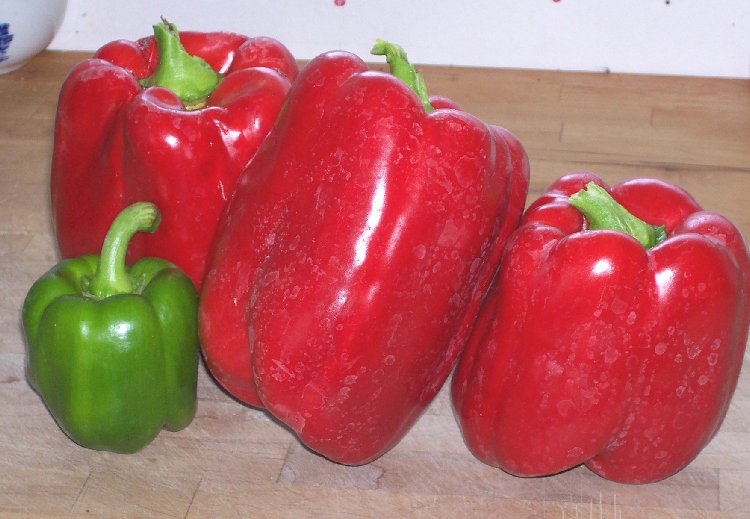
This year I grew very large red peppers in my greenhouse just for this purpose.   Check out the size of these beauties!
Just look at these beautiful red peppers grown in the greenhouse!  They are about 6 inches long or more, and about 5 inches wide.   A normal size green pepper is shown at the left for comparison.

In case you would like to make some red pepper relish yourself, here is the recipe I use:
SWEET RED PEPPER RELISH

About 8 cups of chopped red peppers, chopped in about 1/4 inch dice
1 1/2 c. chopped onions
2 cups cider vinegar
1 3/4 c. sugar
1 T. salt
1 tsp celery seed

     Combine the peppers and onions and add enough boiling water to cover the vegetables.  Let stand for 10 min.  Drain and repeat the boiling water process.   Drain well.  In a large pan, combine the vinegar and sugar and salt until the mixture is hot and the sugar and salt is dissolved.   Add the drained peppers and onions to the pan along with the celery seed and simmer on medium for 15minutes.  Stir frequently.   Ladle the hot relish into hot sterile jars, leaving 1/2 inch headspace.   Put on lids and rings and process jars in a boiling water bath for 15 minutes.   Makes about 4 pints, or 8 jelly jars.  (I usually put this relish in jelly jars)
You can use part green peppers if you don't have all red peppers.   Or use all green peppers if you want - that's good, too!  Sometimes I add a hot pepper or two to the pepper mix. 
******************************************************************
You can tell that fall is on the way very soon!   There are bits of fall colors in the trees now.   Pretty soon we will have peak colors in the trees, and by the end of the month, the leaves will be gone.   It's sad to see summer end, but it was a very hot summer.   I welcome the change of season!   It's so nice to have cooler weather! 
You can see a bit of yellow and orange in the trees now.   Fall is on the way!

Looking the other way down the road, you can just see another patch of orange in the trees. 


Tuesday, August 23, 2016

Here's An Idea

Do you like mushrooms?  I sure do!  In the Polish culture I grew up in, mushrooms were an important part of our cuisine.  I recently read an article about drying mushrooms in the dehydrator, and the lady who wrote the article just used regular white mushrooms like you buy at the store.  She said when they are on sale, it's a good idea to dry up a bunch of them to use when the prices are not so cheap.   Since I am always looking for ways to preserve foods naturally, I thought I would try this!   I have used dry mushrooms before, but they were dry wild mushrooms that we bought at the Polish market in our end of town, and they came from Poland.   They reconstituted well enough, and my Mom would put them in soups or gravy or mixed with sauerkraut.   One of my favorite ways of preparing sauerkraut is to cook it with a little chopped sweet onion, mushrooms, and a handful of barley.   When it is all cooked and mixed together, it makes a great side dish.   So, here I am preparing the mushrooms - I'll give this a try, as I have never done this.  I'm always trying to find things to dry with my dehydrator!  I will use these mushrooms in noodle casseroles, with kraut, added into gravy, or as omelet fillings.  Maybe I will try using the reconstituted slices on pizza and see how that works.   They would also be good added to wild rice hot dishes.
Slicing up several boxes of mushrooms last night in my kitchen!
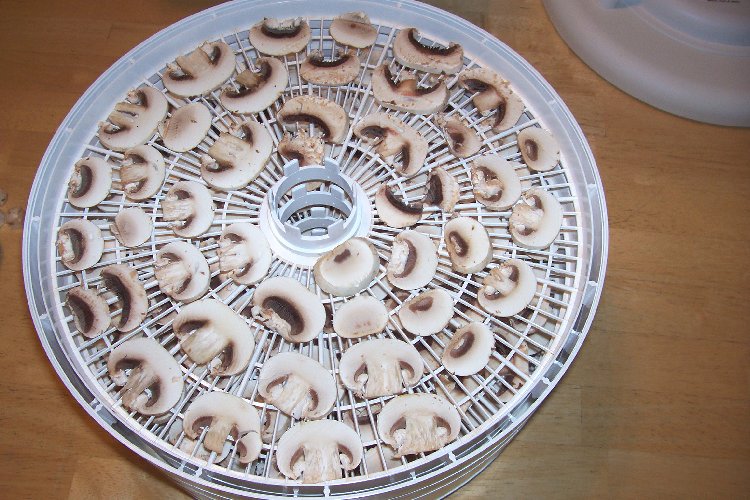
A tray of sliced mushrooms ready for the dehydrator.
A tray of the dried mushrooms.   I dried them for 12 hours at 120 degrees on the dehydrator.
A couple of jars of 'convenience food' for the winter pantry!

Sunday, August 21, 2016

Onions, Onions......Do We Have Lots of Onions!!!

This weekend we harvested our onion crop.   The weeds pretty much take over the garden at this time of the year, and I figured I better get those onions out of the weedy, damp onion patch.   It seemed like a really nice day, so Harold and I began the harvest.  About 1/2 way through the process, it suddenly began to rain - and it didn't just rain, it came down in sheets while we ran to the house.   Of course, after that, when the sun finally came out again, we picked some more, this time in a little bit of mud.   Sure enough, 15 minutes later, another rain shower passed through and quickly went away, leaving us wet again.  And the onions, too!   We decided to give up the harvesting on Saturday, and continue on Sunday.   Today it was really nice and sunny, so we finished the harvest.   I ended up with about 12 big boxes of onions, about 120 lbs!  For the next several days I will be airing the boxes of onions in the sun and also on the porch (when the sun gets too hot).   The dirt should come off the onions easily as they dry.   We will sell some at market, keep plenty for ourselves, and give some away.   I will be cleaning and sorting the onions every day, taking off dry layers until they look real nice for market. 
     So what do I do with all those onions?  I use onions in just about everything I cook!  I also like to put lots of onions in my potato-cheese filled pierogies.   And there's nothing better than onions fried up with potatoes to go with an omelet.   Years ago I went to a German restaurant in New Ulm Minnesota.   There was a German saying stenciled all around the room in big letters, with an English translation underneath.   It basically said this:

"Of this all good cooks have one opinion,
No savory dish without an onion"

I always think of this restaurant when I cook with onions, and their little German saying about onions.
     If stored in a cool place, these onions will last us until next February or March.  I usually grow some sweet onions for salads and making fried onion rings (we have a good sized box full of those, too).  But yellow onions store the best, as compared to red or white onions.
Here I am holding a couple handfuls of freshly dug onions.

Some of the boxes of onions drying on a table in the sun.

 
Even bigger boxes drying!
  
A close-up of some of these big beauties!

Tuesday, August 16, 2016

Everybody Was Busy Today!

Today was a typical late summer day here on Honey B Farm!  Harold was out cutting wood, fixing equipment, and doing outside chores.   I was inside working with vegetables and fruits and canning.  The cats were all busy hunting.  We all had our jobs to do!
     Instead of cutting up the logs right in the woods after felling the trees and stacking them on the back of the pickup, and then hauling them to the house to be unloaded, Harold now drags in big logs from the woods with the tractor and cuts them up right where they will be stacked.   That saves a step or two.   Old people have to work smarter , you know!
This maple log was 30 feet long, and Harold couldn't maneuver it through the woods from behind, so he had no choice but to drag it out backwards!
He positions it right where it can be cut and stacked.
The winter wood pile is getting bigger!   We go through about 10 cords a winter.
He also dug up some potatoes for me from the pasture garden, and put up a solar electric fence and a radio out there because the deer and the raccoon were eating the corn, pumpkins and melons!  Putting a radio in the garden on a talk station seems to deter the animals, as they don't really know what a radio is and think it's a human out there.   If that fails, the electric fence does the trick!
Some of our new potatoes.   Unfortunately, as you can see we have a little bit of potato scab disease.   It doesn't affect the taste of the potatoes, and they are safe to eat, but they just aren't pretty looking.   Potato scab usually results from soil that is not acidic enough, and dry soil conditions, or too much water.  We've had nothing but rain lately, so it is probably too much water.   In spite of the scabbing, I still think the potatoes look nice.
As for me, I was busy canning tomatoes in the morning, and I worked with apples in the afternoon to make 2 gallons of applesauce.  I canned up 14 pints of delicious applesauce from a neighbor's apples.  This won't last through the year, but our friend Joe Miller has some apples we will get tomorrow that I can make more sauce from.   Homemade applesauce is SO good!   It makes a great dessert all winter long, and is wonderful mixed with hot cereal like Cream of Wheat or Malt O Meal on cold mornings.
Jars of beautiful tomatoes I just canned.  They come in handy for soups, stews, casseroles, rice pilafs, chili and chili mac, and for pouring over pork chops or chicken before baking.
A 2 gallon pot of fresh hot applesauce ready to can up.
Jars of applesauce cooling (one jar is set aside so it will seal quicker). 
Not only were Harold and I busy today, but so were the cats!   They daily patrol the farm, hunting and keeping all the unwanted critters at bay.   In all the 12 years I have lived here on the farm, I have never seen a LIVE mouse or vole or shrew or rabbit or chipmunk or gopher.   With anywhere from 12 to 18 farm cats (varies from year to year), those vermin critters don't stand a chance!
Some of my hard working cats enjoying a treat of warm milk this evening.  If you look closely in the upper left hand corner of the photo, you can just see the remains of a freshly caught mouse.   The kitties were doing their job!
Some of the cats get right down into the milk!
Well, this gives you a good idea of how our day went today!  Tomorrow we will get more apples, Harold will cut more wood, and I will pick and work with more garden produce.